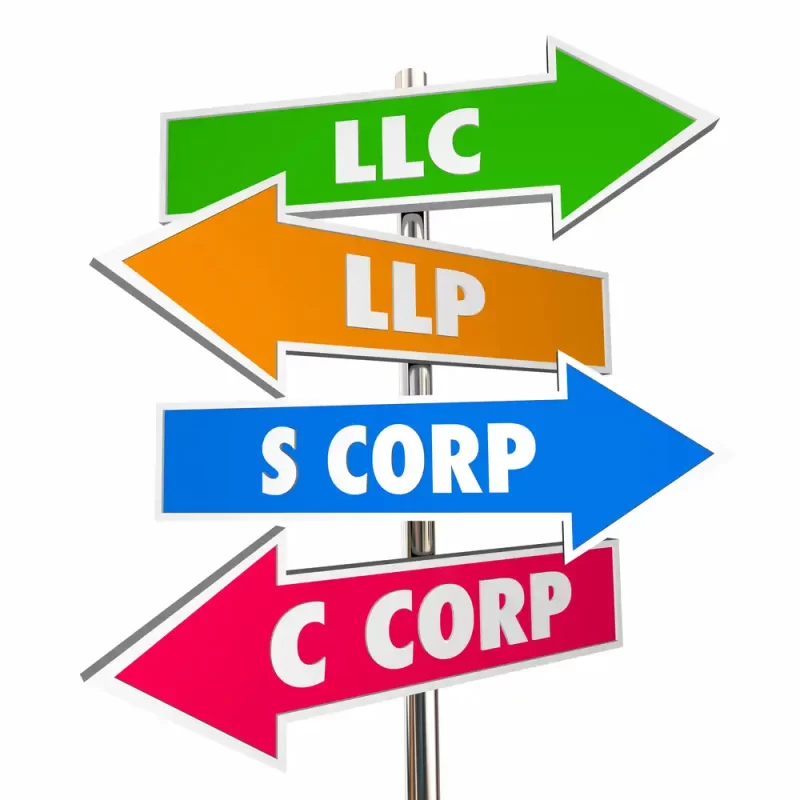
Understanding business entities and their tax structures can save you a great deal of time, money, and potential headaches later on. Limited liability companies (LLCs) and S Corporations (S Corps) are often talked about when it comes to business entities, but it’s not as simple as choosing between one or the other.
Unlike a C Corporation (which taxes shareholders separately from the entity itself), LLCs and S Corps are often subject to only one layer of taxation at the owner level (which can provide a significant amount of tax savings throughout the life of a business).
An LLC is one of the four main legal business structures, while an S Corp is simply a tax classification. That’s why it’s so important to know the differences between them and to understand when and how they may apply.
Tax Considerations
Similar to S Corporations, LLCs, and partnerships are considered to be “pass-through” entities, where the business’s income and expenses flow through to its partners and are reported on their personal tax returns. The entity itself doesn’t pay taxes. The company’s profits, losses, deductions, and credits are passed through to the owners. Because the profits are only taxed at the personal level, you can avoid “double taxation” (which is something that corporations face when they pay corporate income tax).
LLCs and S Corporations treat self-employment taxes differently as well, which are different from income taxes because they apply to the net earnings of the business. The shareholders in an S Corporation aren’t subject to self-employment tax, but the IRS does require them to pay shareholders who contribute substantial services for a “reasonable” salary (which will be subject to payroll tax).
Rental Real Estate Considerations
It’s common for LLCs to own rental real estate, because it offers asset protection. It also limits personal liability, provides a flexible management structure, and allows the company to have an unlimited number of owners. It can even make it easier to attract capital investments and to extend several important tax benefits, but it’s not as common for S Corporations to own real estate because they can inhibit flexibility when distributing property to the owners.
Both LLCs and S Corporations allocate profits and losses according to the percentage of ownership, but the members of an LLC can choose to make “special allocations.” This will allow profits, losses, and other tax benefits (such as depreciation) to be passed through to each member that’s not based on the percentage of ownership. This extra flexibility gives LLCs a strategic advantage over S Corporations.
If you have (or plan to have) more than one rental property, it may be a good idea to set up a separate LLC for each property because all the assets of an LLC are “exposed” if there’s a lawsuit. Insulating both the owners and any other properties you own if there’s a legal dispute can be an advantage. Be sure to speak to a qualified attorney for more information.
Pass-Through Entity Tax Elections
The pass-through entity (PTE) tax elections allow both partnerships and S Corporations to choose to be taxed at the entity level, but only for state income tax purposes. The primary benefit of a PTE election is the federal “deductibility” of any state income tax that’s paid by the entity.
Individual owners of PTE’s can take advantage of a federal tax deduction of state taxes on their pass-through income allocation, which allows them to avoid the $10,000 Federal 1040 Schedule A limit on itemized deductions of state income tax payments. This is more commonly referred to as the state and local tax (SALT) gap. Each state has its own eligibility requirements and PTE election regime that need to be looked at more closely.
Choosing the Most Tax-Efficient Business Structure
Choosing between an LLC and an S Corporation is more than just a tax decision. It’s a strategic choice that can affect your business’s growth, operational flexibility, and long-term success. Both structures have their own set of advantages, but the right choice depends on a careful analysis of your company’s specific needs, goals, and circumstances.
Tax planning is an ongoing process. As your business grows, it’s important to reassess your entity structure and tax strategies to make sure you’re optimizing your tax position. If you have the right tools and professional guidance, you’ll be better able to navigate the complexities of business taxation.
If you’re looking for a CPA in Corpus Christi that can help you with your company’s tax efficiency, be sure to reach out to Jennings & Hawley.